Baryogenesis in a parity solution to the strong CP problem
Abstract
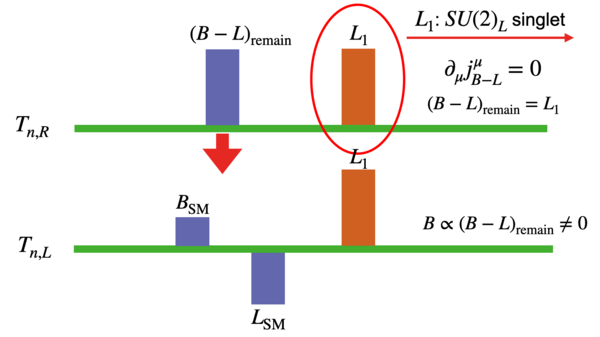
Space-time parity can solve the strong CP problem and introduces a spontaneously broken $SU(2)_R$ gauge symmetry. We investigate the possibility of baryogenesis from a first-order $SU(2)_R$ phase transition similar to electroweak baryogenesis. We consider a model with the minimal Higgs content, for which the strong CP problem is indeed solved without introducing extra symmetry beyond parity. Although the parity symmetry seems to forbid the $SU(2)_R$ anomaly of the $B-L$ symmetry, the structure of the fermion masses can allow for the $SU(2)_R$ sphaleron process to produce non-zero $B-L$ asymmetry of Standard Model particles so that the wash out by the $SU(2)_L$ sphaleron process is avoided. The setup predicts a new hyper-charged fermion whose mass is correlated with the $SU(2)_R$ symmetry breaking scale and hence with the $SU(2)_R$ gauge boson mass, and depending on the origin of CP violation, with an electron electric dipole moment. In a setup where CP violation and the first-order phase transition are assisted by a singlet scalar field, the singlet can be searched for at future colliders.
Related research
Citation (BibTeX)
@article{Harigaya:2022wzt,
  author = {Harigaya, Keisuke and Wang, Isaac R.},
  title = {{Baryogenesis in a parity solution to the strong CP problem}},
  eprint = {2210.16207},
  archiveprefix = {arXiv},
  primaryclass = {hep-ph},
  doi = {10.1007/JHEP11(2023)189},
  journal = {JHEP},
  volume = {11},
  pages = {189},
  year = {2023},
}