The Higgs sector, electroweak symmetry breaking, and the role of phase transitions in the early Universe.
The Higgs field plays a central role in the Standard Model (SM): its nonzero value in the vacuum breaks electroweak symmetry and gives masses to the $W$ and $Z$ bosons, quarks, and charged leptons. The Higgs boson is an excitation of this field, and its interactions provide a window into the mechanism of electroweak symmetry breaking. The Higgs potential determines the vacuum value, the Higgs boson mass, and its self-interactions, whose experimental study remains a central goal of Higgs physics.
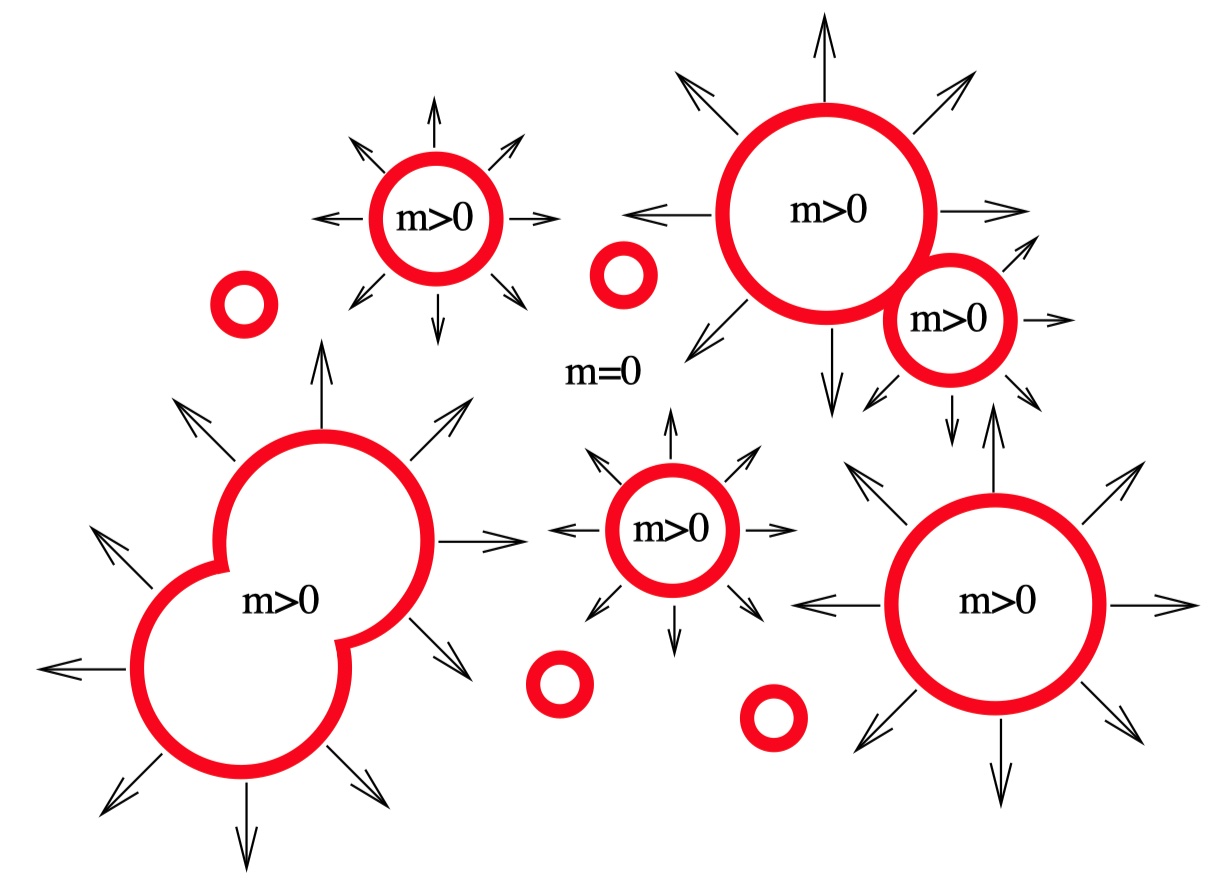
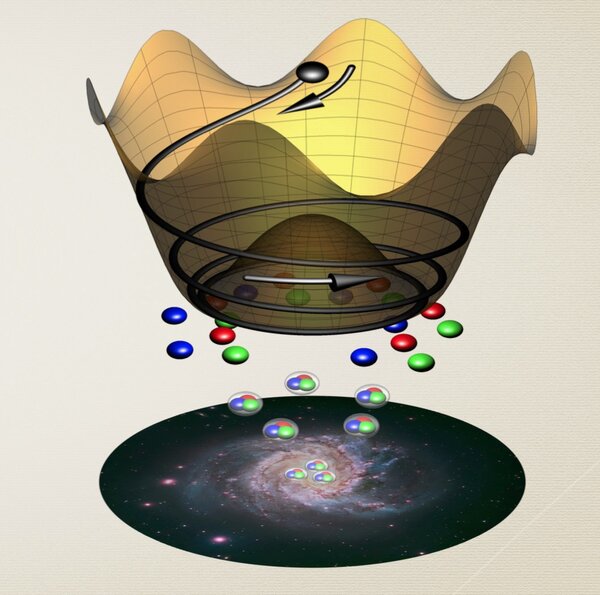
At high temperatures in the early Universe, thermal effects can restore electroweak symmetry. As the Universe cools, the Higgs field develops a nonzero vacuum value and electroweak symmetry is broken. This process is known as the electroweak phase transition (EWPT). In the Standard Model, this occurs through a smooth crossover. New particles coupled to the Higgs or changes to its self-interactions can alter this thermal history and make the transition first-order, with bubbles of the broken phase nucleating and expanding through the plasma. Similar transitions can occur when larger gauge symmetries break, as in grand unified theories and parity-symmetric extensions of the Standard Model.
A first-order phase transition is particularly interesting for two reasons:
Expanding bubble walls can provide the departure from thermal equilibrium needed for electroweak baryogenesis (EWBG), a mechanism for generating the cosmic matter asymmetry.
Bubble collisions and the resulting motion of the plasma can produce gravitational waves that may be observable.
My research follows three directions: new ideas and precise calculations for baryogenesis, bubble wall dynamics, and the effects of topological defects on phase transitions.
Novel ideas for electroweak and EW-like baryogenesis
My work combines new mechanisms for electroweak baryogenesis with detailed calculations of the underlying phase transitions. I also explore analogous mechanisms at higher symmetry-breaking scales, motivated by broader extensions of the Standard Model.
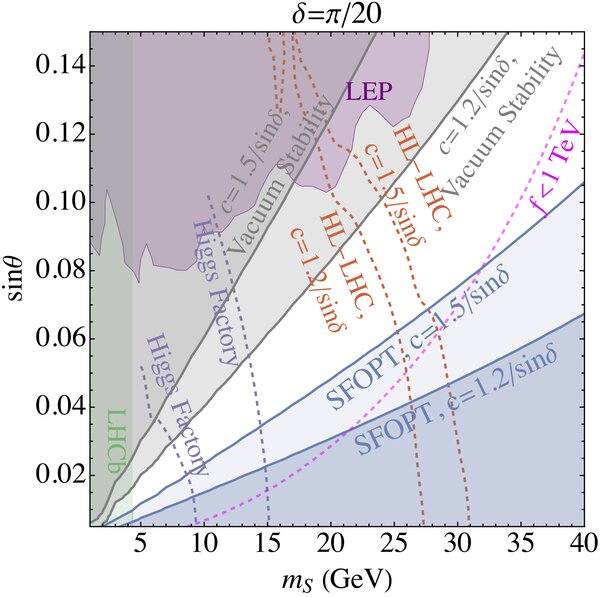
We showed that an axion-like particle (ALP) coupled to the Higgs can drive a strong first-order electroweak phase transition. The ALP can have a mass from tens of $\mathrm{MeV}$ to a few $\mathrm{GeV}$, opening complementary ways to test this scenario through cosmic microwave background observations and rare meson decays, with additional constraints from supernova cooling.
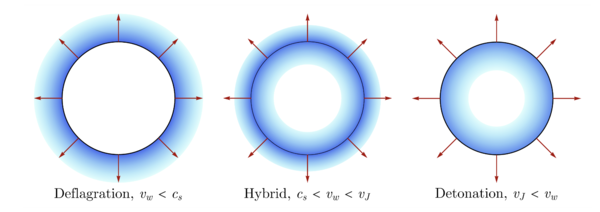
The bubble wall velocity is a key input to predictions of both the baryon asymmetry and the gravitational-wave signal. My work aims to determine this velocity from the underlying particle model and the response of the plasma.
The standard approach determines the force on the wall using the scalar equation of motion (EOM). In local thermal equilibrium (LTE), an entropy-conservation condition provides an equivalent way to determine the wall velocity. We developed efficient algorithms that use this condition to compute the velocity for a general equation of state (EOS).
We have extended this framework to include entropy production and implemented numerical calculations for both general and template-model equations of state.
Topological defects in EWPT
Many extensions of the Standard Model that support a first-order EWPT also involve the spontaneous breaking of additional symmetries, such as $\mathbb{Z}_2$, $\mathbb{Z}_N$, or continuous symmetry groups. When these symmetries break before the electroweak transition, they can produce topological defects. Domain walls, for example, can seed bubble nucleation and alter how the electroweak transition proceeds.
A precise determination of the bubble wall velocity $v_w$ is crucial for making accurate predictions of the baryon asymmetry and gravitational wave (GW) signals in models of electroweak baryogenesis (EWBG). Working in the local thermal equilibrium approximation, we exploit entropy conservation to present efficient algorithms for computing $v_w$, significantly streamlining the calculation. We then explore the parameter dependencies of $v_w$, focusing on two sample models capable of enabling a strong first-order electroweak phase transition: a $\mathbb{Z}_2$-symmetric singlet extension of the SM, and a model for baryogenesis with CP violation in the dark sector. We study correlations among $v_w$ and the two common measures of phase transition strength, $\alpha_n$ and $v_n/T_n$. Interestingly, we find a relatively model-insensitive relationship between $v_n/T_n$ and $\alpha_n$. We also observe an upper bound on $\alpha_n$ for the deflagration/hybrid wall profiles naturally compatible with EWBG, the exact value for which varies between models, significantly impacting the strength of the GW signals. In summary, our work provides a framework for exploring the feasibility of EWBG models in light of future GW signals.
@article{Carena:2025flp,author={Carena, Marcela and Ireland, Aurora and Ou, Tong and Wang, Isaac R.},title={{The discriminant power of bubble wall velocities: gravitational waves and electroweak baryogenesis}},eprint={2504.17841},archiveprefix={arXiv},primaryclass={hep-ph},reportnumber={FERMILAB-PUB-25-0266-T},doi={10.1007/JHEP09(2025)175},journal={JHEP},volume={09},pages={175},year={2025},}
Axion-like particles (ALPs) can be naturally lighter than the electroweak scale. We consider an ALP that couples to the Standard Model Higgs to achieve the strong first-order electroweak phase transition. We discuss the two-field dynamics of the phase transition and the associated computation in detail and identify the viable parameter space. The ALP mass can be from the MeV to GeV scale. Baryon asymmetry can be explained by local baryogenesis without violating the electron electric dipole moment bound. The viable parameter space can be probed through Higgs exotic decay, rare kaon decay, the electron electric dipole moment, and the effective number of neutrinos in the cosmic microwave background. The gravitational-wave signal is too weak to be detected.
@article{Harigaya:2023bmp,author={Harigaya, Keisuke and Wang, Isaac R.},title={{ALP-assisted strong first-order electroweak phase transition and baryogenesis}},eprint={2309.00587},archiveprefix={arXiv},primaryclass={hep-ph},doi={10.1007/JHEP04(2024)108},journal={JHEP},volume={04},pages={108},year={2024},}
Space-time parity can solve the strong CP problem and introduces a spontaneously broken $SU(2)_R$ gauge symmetry. We investigate the possibility of baryogenesis from a first-order $SU(2)_R$ phase transition similar to electroweak baryogenesis. We consider a model with the minimal Higgs content, for which the strong CP problem is indeed solved without introducing extra symmetry beyond parity. Although the parity symmetry seems to forbid the $SU(2)_R$ anomaly of the $B-L$ symmetry, the structure of the fermion masses can allow for the $SU(2)_R$ sphaleron process to produce non-zero $B-L$ asymmetry of Standard Model particles so that the wash out by the $SU(2)_L$ sphaleron process is avoided. The setup predicts a new hyper-charged fermion whose mass is correlated with the $SU(2)_R$ symmetry breaking scale and hence with the $SU(2)_R$ gauge boson mass, and depending on the origin of CP violation, with an electron electric dipole moment. In a setup where CP violation and the first-order phase transition are assisted by a singlet scalar field, the singlet can be searched for at future colliders.
@article{Harigaya:2022wzt,author={Harigaya, Keisuke and Wang, Isaac R.},title={{Baryogenesis in a parity solution to the strong CP problem}},eprint={2210.16207},archiveprefix={arXiv},primaryclass={hep-ph},doi={10.1007/JHEP11(2023)189},journal={JHEP},volume={11},pages={189},year={2023},}
The baryon asymmetry of the universe may be explained by rotations of the QCD axion in field space and baryon number violating processes. We consider the minimal extension of the Standard Model by a non-Abelian gauge interaction, $SU(2)_R$, whose sphaleron process violates baryon number. Assuming that axion dark matter is also created from the axion rotation by the kinetic misalignment mechanism, the mass scale of the $SU(2)_R$ gauge boson is fixed as a function of the QCD axion decay constant, and vise versa. Significant portion of the parameter space has already been excluded by new gauge boson searches, and the high-luminocity LHC will further probe the viable parameter space.
@article{Harigaya:2021txz,author={Harigaya, Keisuke and Wang, Isaac R.},title={{Axiogenesis from $SU(2)_R$ phase transition}},eprint={2107.09679},archiveprefix={arXiv},primaryclass={hep-ph},doi={10.1007/JHEP10(2021)022},journal={JHEP},volume={10},pages={022},year={2021},note={[Erratum: JHEP 12, 193 (2021)]},}
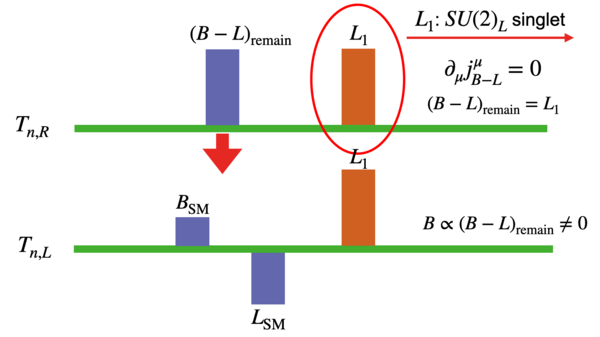
We propose a framework where a phase transition associated with a gauge symmetry breaking that occurs (not far) above the electroweak scale sets a stage for baryogenesis similar to the electroweak baryogenesis in the Standard Model. A concrete realization utilizes the breaking of $SU(2)_R \times U(1)_X \rightarrow U(1)_Y$. New chiral fermions charged under the extended gauge symmetry have nonzero lepton numbers, which makes the $B-L$ symmetry anomalous. The new lepton sector contains a large flavor-dependent CP violation, similar to the Cabibbo-Kobayashi-Maskawa phase, without inducing sizable electric dipole moments of the Standard Model particles. A bubble wall dynamics associated with the first-order phase transition and $SU(2)_R$ sphaleron processes generate a lepton asymmetry, which is transferred into a baryon asymmetry via the ordinary electroweak sphaleron process. Unlike the Standard Model electroweak baryogenesis, the new phase transition can be of the strong first order and the new CP violation is not significantly suppressed by Yukawa couplings, so that the observed asymmetry can be produced. The model can be probed by collider searches for new particles and the observation of gravitational waves. One of the new leptons becomes a dark matter candidate. The model can be also embedded into a left-right symmetric theory to solve the strong CP problem.
@article{Fujikura:2021abj,author={Fujikura, Kohei and Harigaya, Keisuke and Nakai, Yuichiro and Wang, Isaac R.},title={{Electroweak-like baryogenesis with new chiral matter}},eprint={2103.05005},archiveprefix={arXiv},primaryclass={hep-ph},doi={10.1007/JHEP07(2021)224},journal={JHEP},volume={07},pages={224},year={2021},note={[Erratum: JHEP 12, 192 (2021), Erratum: JHEP 1, 156 (2022), Erratum: JHEP 01, 156 (2022)]},}
 JHEP, 2021[Erratum: JHEP 12, 193 (2021)]
 Research: Higgs & phase transitionsJHEP, 2021[Erratum: JHEP 12, 192 (2021), Erratum: JHEP 1, 156 (2022), Erratum: JHEP 01, 156 (2022)]