Laboratory searches for new particles and interactions through colliders and beam-dump experiments.
Accelerator experiments allow us to produce new particles in the laboratory and study their interactions and decays. Their discovery potential depends on the available energy, the number of collisions, and the detector’s ability to distinguish a signal from background. High-energy colliders can extend the search to heavier particles, while intense beams striking fixed targets provide access to light particles with very small couplings.
My research develops search strategies and evaluates the discovery potential of proposed and operating experiments. I focus on two directions: future lepton colliders and beam-dump searches.
Future lepton colliders
Lepton colliders bring beams of electrons or muons into collision. Their well-characterized initial state and relatively clean backgrounds compared with hadron colliders allow precise studies of the particles produced and the interactions responsible for their production.
These machines probe new physics in two complementary ways. When enough energy is available, new particles can be produced directly and identified through their decay products or the missing energy carried by invisible particles. Precision measurements can also probe heavier particles through their effects on processes involving known particles.
Well-known future lepton collider proposals include, but not limited to, high-energy muon colliders and FCC-ee. Another proposal is $\mu$TRISTAN, developed in Japan, which would collide a $1~\mathrm{TeV}$ $\mu^+$ beam with either another $\mu^+$ beam of the same energy or a $30~\mathrm{GeV}$ $e^-$ beam. This facility offers distinctive opportunities to search for new physics and has a relatively promising timeline among future collider proposals.
My research explores how future lepton colliders can probe extensions of the Higgs and gauge sectors.
Beam dumps
Beam-dump experiments direct an intense particle beam into a thick target. The collisions and the decays of particles produced in the target can create light new particles, including dark-sector mediators. Material downstream absorbs much of the ordinary collision debris, while weakly interacting particles can travel through it and reach a detector. The large number of beam particles makes these experiments sensitive to rare production processes and small couplings for particles with masses in the MeV-GeV range.
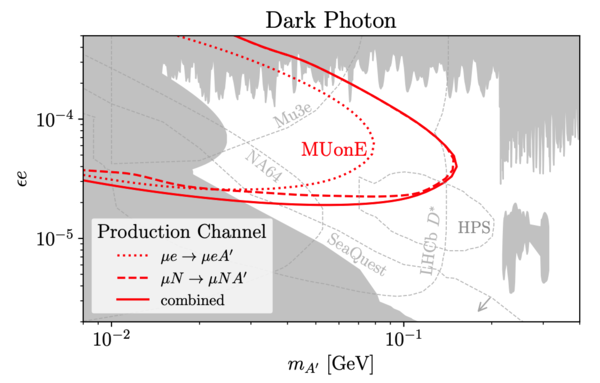
My work develops search strategies for light new particles at beam-dump and fixed-target experiments. For example, we showed that MUonE’s precise tracking enables displaced-vertex searches for dark photons, other vector bosons, and thermal relic dark matter.
The upcoming MUonE experiment aims to precisely measure the running of the fine structure constant via elastic muon-electron scattering, to shed light on the current tension in the muon’s anomalous magnetic moment. In addition to its primary function as a precision experiment, MUonE also offers a unique testing ground to probe long-lived vector bosons. Such vector bosons can be produced via $\mu e \to \mu e V$ or $\mu N \to \mu N V$ scattering and decay into an electron/positron pair a few centimeters away from the interaction point. With its high-resolution tracking system and unique geometric design, MUonE is wellsuited to reconstruct displaced vertices close to the target, allowing it to probe parameter space previously unattainable at colliders and longer-baseline beam dump experiments. We present a comprehensive study of the discovery potential of BSM vector boson mediators at the MUonE experiment. We show that MUonE can fill the long-standing gap in the parameter space of vector boson mediators with masses up to around 100 MeV.
@article{Rocha:2025rqc,author={Rocha, Duncan and Wang, Isaac R.},title={{Filling the gap: hunting for vector bosons at the MUonE experiment with displaced decay signature}},eprint={2511.03222},archiveprefix={arXiv},primaryclass={hep-ph},reportnumber={FERMILAB-PUB-25-0795-T},doi={10.1007/JHEP03(2026)190},journal={JHEP},volume={03},pages={190},year={2026},}
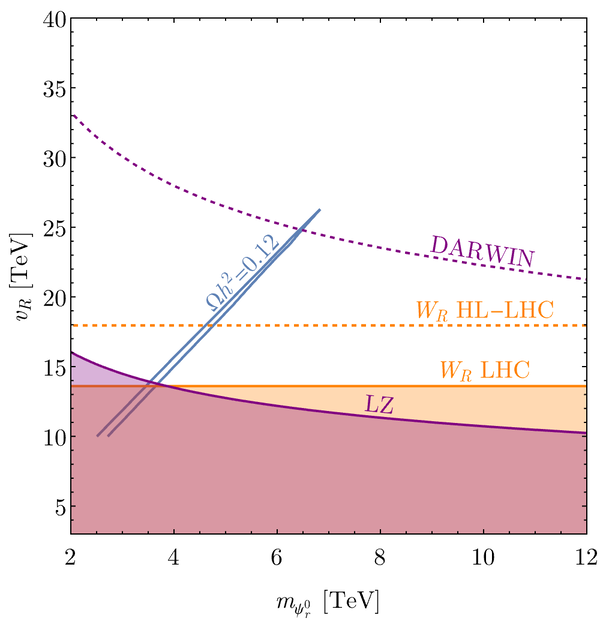
We consider weakly interacting massive particle (WIMP) dark matter in a Parity solution to the strong CP problem. The WIMP phenomenology can be drastically affected by the presence of Parity partners of the WIMP and electroweak gauge bosons. We focus on a Parity extension of $SU(2)_L$-doublet fermion dark matter, identify the viable parameter space, and derive the predictions of the theory. We find that the Parity symmetry breaking scale is bounded from above, with the bound given by $25-60$ $\rm TeV$, depending on whether or not dark matter and its Parity partner coannihilate with each other. The High-Luminosity Large Hadron Collider, future colliders, and direct and indirect detection experiments can probe the parameter space further, with correlated signal rates.
@article{Baldwin:2025oqt,author={Baldwin, Matthew J. and Harigaya, Keisuke and Wang, Isaac R.},title={{Upper bound on Parity breaking scale for doublet WIMP dark matter}},eprint={2507.22113},archiveprefix={arXiv},primaryclass={hep-ph},reportnumber={FERMILAB-PUB-25-0524-T},doi={10.1007/JHEP09(2026)136},journal={JHEP},volume={09},pages={136},year={2026},}
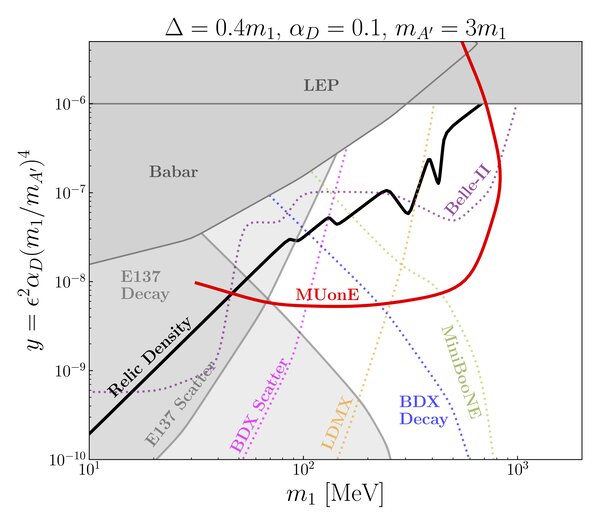
The MUonE experiment aims to extract the hadronic contribution to the muon anomalous magnetic moment from a precise measurement of the muon-electron differential scattering cross section. We show that MUonE can also discover thermal relic dark matter using only its nominal experimental setup. Our search strategy is sensitive to models of dark matter in which pairs of pseudo-Dirac fermions are produced in muon-nucleus scattering in the target, and the heavier state decays semi-visibly to yield dilepton pairs displaced downstream from the interaction point. This approach can probe sub-GeV thermal-relic dark matter whose cosmological abundance is governed by the same model parameters that set the MUonE signal strength. Furthermore, our results show that the downstream ECAL plays a key role in rejecting backgrounds for this search, thereby providing strong motivation for the MUonE to keep this component in the final experimental design.
@article{Krnjaic:2024ols,author={Krnjaic, Gordan and Rocha, Duncan and Wang, Isaac R.},title={{Discovering Dark Matter with the MUonE Experiment}},eprint={2409.00170},archiveprefix={arXiv},primaryclass={hep-ph},reportnumber={FERMILAB-PUB-24-0554-T},doi={10.1103/PhysRevLett.134.161801},journal={Phys. Rev. Lett.},volume={134},number={16},pages={161801},year={2025},}
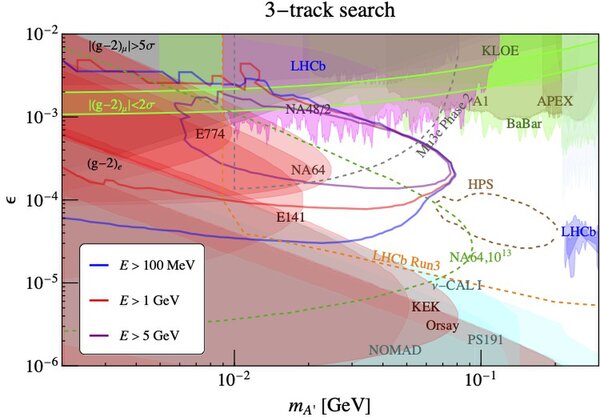
MUonE is a proposed experiment designed to measure the hadronic vacuum polarization contribution to muon $g-2$ through elastic $\mu-e$ scattering. As such it employs an extremely high-resolution tracking apparatus. We point out that this makes MUonE also a very promising experiment to search for displaced vertices from light, weakly-interacting new particles. We demonstrate its potential by showing how it has excellent sensitivity to dark photons in the mass range $10~\mathrm{MeV} \le m_{A'} \le 100~\mathrm{MeV}$ and kinetic mixing parameter $10^{-5} \le \epsilon e \le 10^{-3}$, through the process $\mu^{\pm}\, e^- \to \mu^{\pm}\, e^-\, A'$ followed by $A'\to e^+e^-$.
@article{Galon:2022xcl,author={Galon, Iftah and Shih, David and Wang, Isaac R.},title={{Dark photons and displaced vertices at the MUonE experiment}},eprint={2202.08843},archiveprefix={arXiv},primaryclass={hep-ph},doi={10.1103/PhysRevD.107.095003},journal={Phys. Rev. D},volume={107},number={9},pages={095003},year={2023},}
 Phys. Rev. Lett., 2024