Cosmological and astrophysical signatures of new physics
New physics through its effects on cosmic evolution, dark matter, and astrophysical observations.
The Universe provides a way to study new particles through their effects on cosmic evolution and the signals that reach us from astrophysical sources. The abundance of dark matter, the matter–antimatter asymmetry, and the properties of cosmic messengers can all carry information about physics beyond the Standard Model.
My research follows three directions: axion cosmology, dark matter and the cosmic thermal history, and astrophysical probes of new physics.
Axion cosmology
The axion was proposed to explain why strong interactions preserve charge–parity (CP) symmetry to such high precision, a puzzle known as the strong CP problem. The attracting part is that axion can also be a well-motivated dark matter candidate.
Traditionally, people think axion dark matter is produced via misalignment mechanism, where the axion field was at a static value away from the potential mininum at the beginning of the universe, and then starts oscillating around the minimum. Recently, it’s been proposed that axion field may have a large initial rotating kinetic energy, known as kinetic misalignment mechnism. This initial rotation might also help achieving baryogenesis, known as axiogenesis.
These possibilities motivate a broader study of axion dynamics and their connections to dark matter and baryogenesis. On the one hand, we need a good particle physics model to achieve the right cosmology of rotating axion and axiogenesis. On the other hand, we would like to know how to distinguish whether the axion is initially rotating or at rest.
Besides axion, there are a few other possibilities of dark matter production in the early universe, including freeze-out mechanism, freeze-in mechanism, or something else.
With the dark matter production, the thermal history of our universe could be modified. Their production, annihilation, and decay can redistribute energy among the particles in the cosmic plasma, while phase transitions can change the state of matter and the interactions that govern its evolution. These changes can leave signatures in the primordial abundances of light elements, the cosmic microwave background, and the relic neutrino population. Cosmological observations thus allow us to test new particles through their effects on the early Universe.
Astrophysical sources produce particles over a wide range of energies and send them across enormous distances. Neutrinos and cosmic rays provide information about these sources and the interactions encountered along their journey. New particles or forces can change the signals that reach Earth, making astrophysical observations a way to probe fundamental physics.
Neutrinos are particularly useful because their weak interactions allow them to travel through dense environments and over cosmic distances. Even small additional interactions can become relevant over such long journeys and modify the observed energy spectrum. Cosmic rays provide another opportunity: some reach energies far beyond those available in laboratory particle beams. Their collisions with matter can produce new particles, allowing the Universe to act as a natural accelerator.
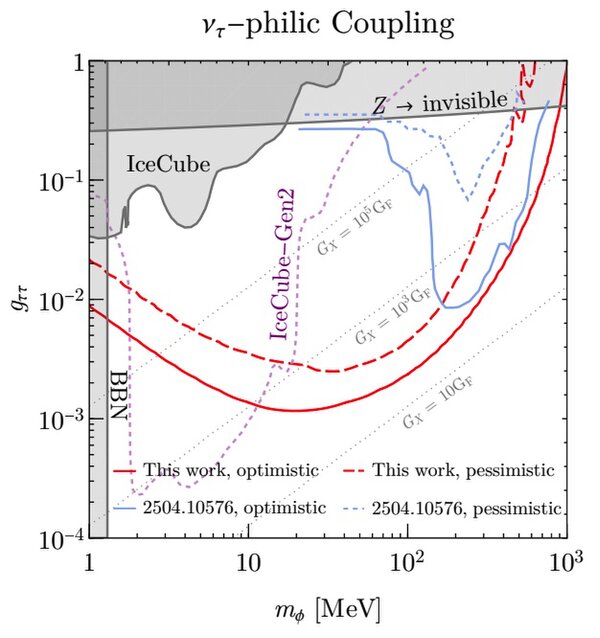
Neutrino self-interaction beyond the Standard Model is well motivated by the nonzero masses of neutrinos, which are the only known particles guaranteed to have new physics. Cosmic messengers, especially neutrinos, play a central role in probing new physics, as they provide experimental conditions far beyond the reach of laboratories and serve as the link between laboratory fundamental-physics discoveries and their roles in the Universe, where many new physics motivations originate. In this work, we propose a novel probe of neutrino self-interactions through ultra-high-energy neutrinos scattering off the cosmic neutrino background when the lightest neutrino species remains relativistic today. This allows us to “Widen the Resonance” of such scattering. Meanwhile, we also provide a semi-analytic framework for cosmogenic UHE neutrino production, avoiding computationally intensive simulations and yielding results precise enough for BSM studies. The widened resonance enables future ultrahigh-energy neutrino telescopes, in particular GRAND, to probe mediator masses from MeV to GeV, reaching couplings down to $g \sim 10^{-3}$ – up to two orders of magnitude beyond current bounds. Our results enhance the discovery potential of $\nu$SI in the high-mass regime, potentially offering crucial insights into the connections between the neutrino sector and dark sector.
@article{Machado:2025ltu,author={Machado, Pedro A. N. and Wang, Isaac R. and Xu, Xun-Jie and Zhou, Bei},title={{Widen the resonance at ultra-high energies: novel probes of neutrino self-interactions in the high-mass regime}},eprint={2512.00165},archiveprefix={arXiv},primaryclass={hep-ph},reportnumber={FERMILAB-PUB-25-0853-T},doi={10.1088/1475-7516/2026/07/064},journal={JCAP},volume={07},pages={064},year={2026},}
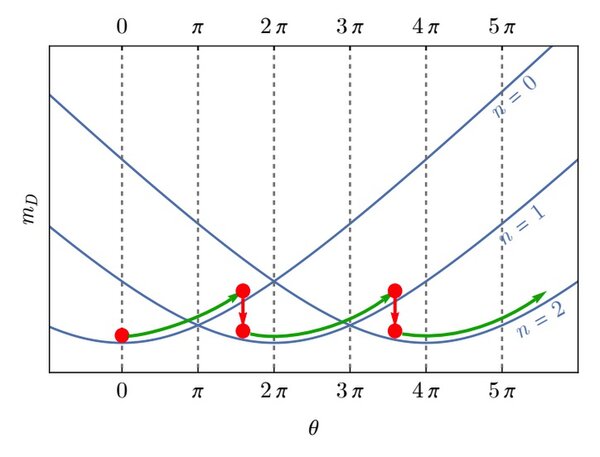
We introduce a novel mechanism where the kinetic energy of a rotating axion can be dissipated by the interactions with dark magnetic monopoles. This mechanism leads to a framework where the QCD axion and dark monopoles account for the dark matter density, and the observed baryon asymmetry is generated through the rotating QCD axion via axiogenesis. The monopoles acquire masses from a nonzero axion field, and they can transition between different quantized dyonic levels in the presence of a rotating axion field. The axion kinetic energy is dissipated by the transition, and thus the axion abundance is depleted to the observed dark matter abundance. We predict that the axion decay constant should be below $10^9$ GeV to explain the observed dark matter and baryon densities.
@article{Co:2025lcs,author={Co, Raymond T. and Harigaya, Keisuke and Wang, Isaac R. and Xiao, Huangyu},title={{Dark matter and baryon asymmetry from monopole-axion interactions}},eprint={2511.10603},archiveprefix={arXiv},primaryclass={hep-ph},reportnumber={CETUP2025-015, FERMILAB-PUB-25-0812-T},doi={10.1007/JHEP07(2026)189},journal={JHEP},volume={07},pages={189},year={2026},}
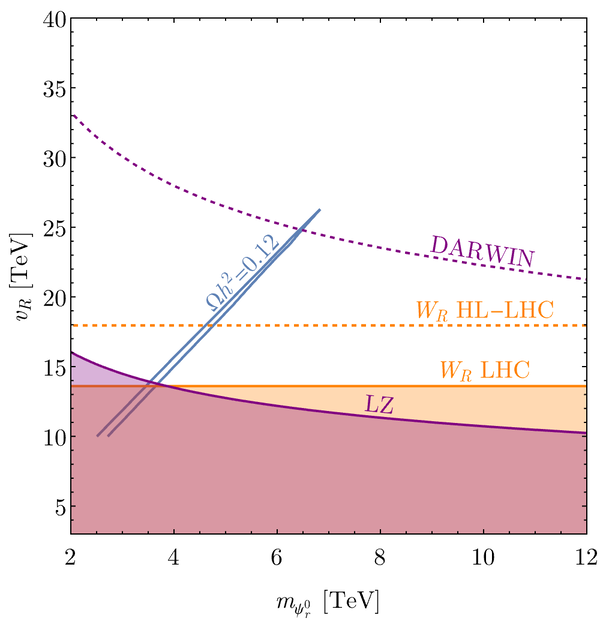
We consider weakly interacting massive particle (WIMP) dark matter in a Parity solution to the strong CP problem. The WIMP phenomenology can be drastically affected by the presence of Parity partners of the WIMP and electroweak gauge bosons. We focus on a Parity extension of $SU(2)_L$-doublet fermion dark matter, identify the viable parameter space, and derive the predictions of the theory. We find that the Parity symmetry breaking scale is bounded from above, with the bound given by $25-60$ $\rm TeV$, depending on whether or not dark matter and its Parity partner coannihilate with each other. The High-Luminosity Large Hadron Collider, future colliders, and direct and indirect detection experiments can probe the parameter space further, with correlated signal rates.
@article{Baldwin:2025oqt,author={Baldwin, Matthew J. and Harigaya, Keisuke and Wang, Isaac R.},title={{Upper bound on Parity breaking scale for doublet WIMP dark matter}},eprint={2507.22113},archiveprefix={arXiv},primaryclass={hep-ph},reportnumber={FERMILAB-PUB-25-0524-T},doi={10.1007/JHEP09(2026)136},journal={JHEP},volume={09},pages={136},year={2026},}
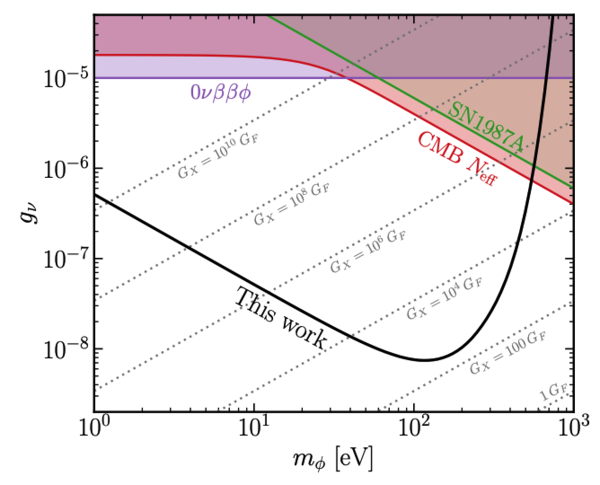
Neutrino self-interactions beyond the standard model have profound implications in astrophysics and cosmology. In this work, we study an uncharted scenario in which one of the three neutrino species has a mass much smaller than the temperature of the cosmic neutrino background. This results in a relativistic component that significantly broadens the absorption feature on the astrophysical neutrino spectra, in contrast to the sharply peaked absorption expected in the extensively studied scenarios assuming a fully nonrelativistic cosmic neutrino background. By solving the Boltzmann equations for neutrino absorption and regeneration, we demonstrate that this mechanism provides novel sensitivity to sub-keV mediator masses, well below the traditional $\sim 1$–100 MeV range. Future observations of the diffuse supernova neutrino background with Hyper-Kamiokande could probe coupling strengths down to $g \sim 10^{-8}$, surpassing existing constraints by orders of magnitude. These findings open new directions for discoveries and offer crucial insights into the interplay between neutrinos and the dark sector.
@article{Wang:2025qap,author={Wang, Isaac R. and Xu, Xun-Jie and Zhou, Bei},title={{Widen the Resonance: Probing a New Regime of Neutrino Self-Interactions with Astrophysical Neutrinos}},eprint={2501.07624},archiveprefix={arXiv},primaryclass={hep-ph},reportnumber={FERMILAB-PUB-25-0016-T},doi={10.1103/9ddp-j1z9},journal={Phys. Rev. Lett.},volume={135},number={18},pages={181002},year={2025},}
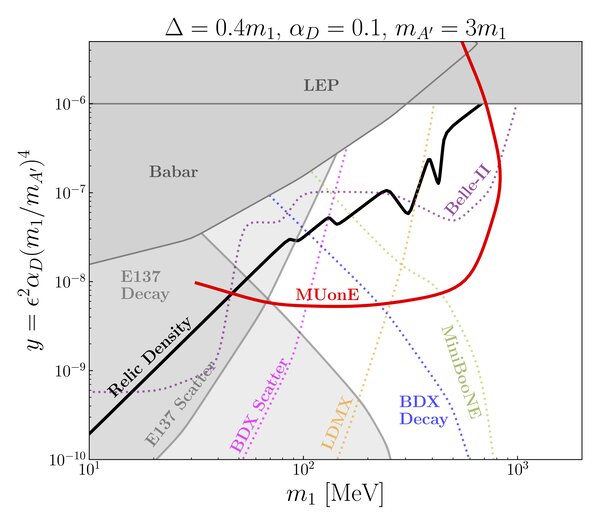
The MUonE experiment aims to extract the hadronic contribution to the muon anomalous magnetic moment from a precise measurement of the muon-electron differential scattering cross section. We show that MUonE can also discover thermal relic dark matter using only its nominal experimental setup. Our search strategy is sensitive to models of dark matter in which pairs of pseudo-Dirac fermions are produced in muon-nucleus scattering in the target, and the heavier state decays semi-visibly to yield dilepton pairs displaced downstream from the interaction point. This approach can probe sub-GeV thermal-relic dark matter whose cosmological abundance is governed by the same model parameters that set the MUonE signal strength. Furthermore, our results show that the downstream ECAL plays a key role in rejecting backgrounds for this search, thereby providing strong motivation for the MUonE to keep this component in the final experimental design.
@article{Krnjaic:2024ols,author={Krnjaic, Gordan and Rocha, Duncan and Wang, Isaac R.},title={{Discovering Dark Matter with the MUonE Experiment}},eprint={2409.00170},archiveprefix={arXiv},primaryclass={hep-ph},reportnumber={FERMILAB-PUB-24-0554-T},doi={10.1103/PhysRevLett.134.161801},journal={Phys. Rev. Lett.},volume={134},number={16},pages={161801},year={2025},}
Neutrinos are often considered as a portal to new physics beyond the Standard Model (SM) and might possess phenomenologically interesting interactions with dark matter (DM). This paper examines the cosmological imprints of DM that interacts with and is produced from SM neutrinos at temperatures below the MeV scale. We take a model-independent approach to compute the evolution of DM in this framework and present analytic results which agree well with numerical ones. Both freeze-in and freeze-out regimes are included in our analysis. Furthermore, we demonstrate that the thermal evolution of neutrinos might be substantially affected by their interaction with DM. We highlight two distinctive imprints of such DM on neutrinos: (i) a large, negative contribution to $N_{\rm eff}$, which is close to the current experimental limits and will readily be probed by future experiments; (ii) spectral distortion of the cosmic neutrino background (C$\nu$B) due to DM annihilating into neutrinos, a potentially important effect for the ongoing experimental efforts to detect C$\nu$B.
@article{Wang:2023csv,author={Wang, Isaac R. and Xu, Xun-Jie},title={{Imprints of light dark matter on the evolution of cosmic neutrinos}},eprint={2312.17151},archiveprefix={arXiv},primaryclass={hep-ph},reportnumber={FERMILAB-PUB-23-0829-T},doi={10.1088/1475-7516/2024/05/050},journal={JCAP},volume={05},pages={050},year={2024},}
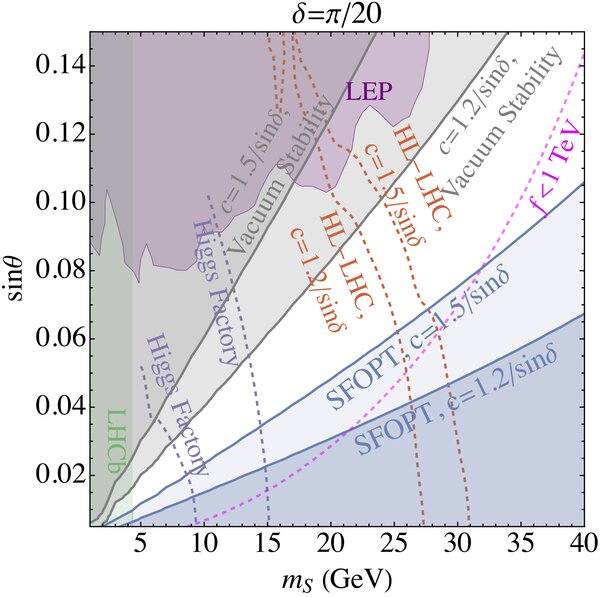
Axion-like particles (ALPs) can be naturally lighter than the electroweak scale. We consider an ALP that couples to the Standard Model Higgs to achieve the strong first-order electroweak phase transition. We discuss the two-field dynamics of the phase transition and the associated computation in detail and identify the viable parameter space. The ALP mass can be from the MeV to GeV scale. Baryon asymmetry can be explained by local baryogenesis without violating the electron electric dipole moment bound. The viable parameter space can be probed through Higgs exotic decay, rare kaon decay, the electron electric dipole moment, and the effective number of neutrinos in the cosmic microwave background. The gravitational-wave signal is too weak to be detected.
@article{Harigaya:2023bmp,author={Harigaya, Keisuke and Wang, Isaac R.},title={{ALP-assisted strong first-order electroweak phase transition and baryogenesis}},eprint={2309.00587},archiveprefix={arXiv},primaryclass={hep-ph},doi={10.1007/JHEP04(2024)108},journal={JHEP},volume={04},pages={108},year={2024},}
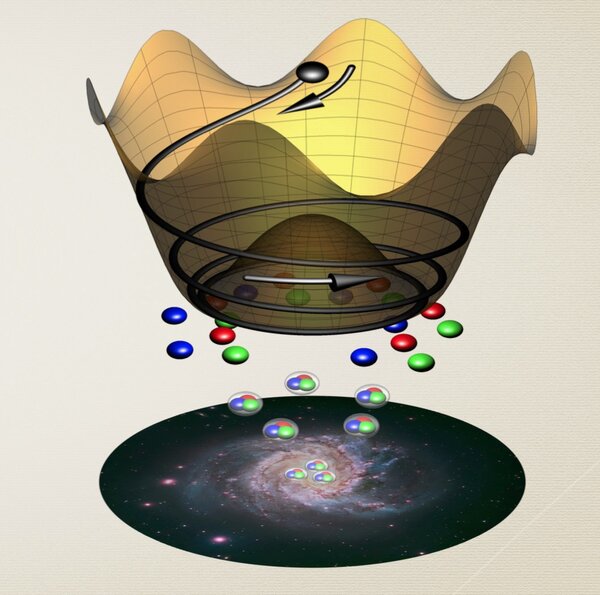
The baryon asymmetry of the universe may be explained by rotations of the QCD axion in field space and baryon number violating processes. We consider the minimal extension of the Standard Model by a non-Abelian gauge interaction, $SU(2)_R$, whose sphaleron process violates baryon number. Assuming that axion dark matter is also created from the axion rotation by the kinetic misalignment mechanism, the mass scale of the $SU(2)_R$ gauge boson is fixed as a function of the QCD axion decay constant, and vise versa. Significant portion of the parameter space has already been excluded by new gauge boson searches, and the high-luminocity LHC will further probe the viable parameter space.
@article{Harigaya:2021txz,author={Harigaya, Keisuke and Wang, Isaac R.},title={{Axiogenesis from $SU(2)_R$ phase transition}},eprint={2107.09679},archiveprefix={arXiv},primaryclass={hep-ph},doi={10.1007/JHEP10(2021)022},journal={JHEP},volume={10},pages={022},year={2021},note={[Erratum: JHEP 12, 193 (2021)]},}
 Widen the Resonance: Probing a New Regime of Neutrino Self-Interactions with Astrophysical NeutrinosResearch: Cosmology & astrophysicsPhys. Rev. Lett., 2025
 Phys. Rev. Lett., 2024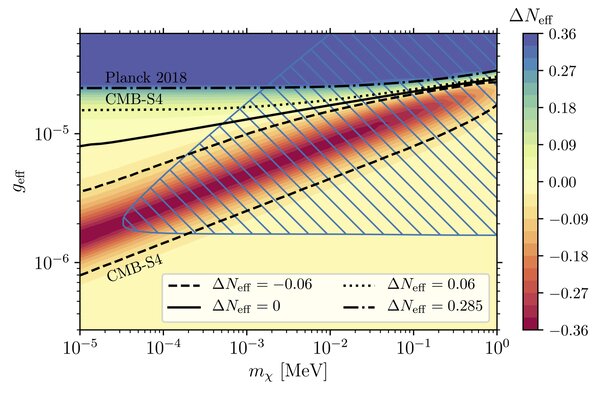
 JHEP, 2021[Erratum: JHEP 12, 193 (2021)]